

In May 2025, the City of West Kelowna adopted its first Accessibility Plan, which includes three goals and sixteen actions aimed at creating a more accessible and inclusive community. As an early implementation priority, the City committed to assessing the accessibility of public spaces and taking a community-led approach to better understand and address barriers experienced by people with disabilities.
With support from Urban Matters and Urban Systems, that opportunity became a project that put community members at the center of the work. Funded through a $25,000 Age-Friendly grant from BC Healthy Communities, the project focused on auditing active transportation infrastructure to better understand how people of all abilities access essential services like health care, groceries, and community support.
A Different Approach to Work
Traditionally, consultants or staff members conduct audits, but the project team wanted a more collaborative, community-based approach.
The result is a lived experience auditing tool, based on insight from people with diverse abilities, and integrated with GIS-enabled data collection and mapping. Our Urban team drew on life experiences of disability to train ten community members in using the audit tool. Community auditors have personal relationships with disability, and include seniors, youth, and individuals with mobility, low vision, and other accessibility challenges. Trained auditors used what they learned, and their own life experiences, to evaluate accessibility features in key public spaces, and submit their responses through the audit tool.
The result? Over 750 audits completed, outnumbering what a traditional, consultant-led approach would have achieved. The volume of responses helped identify common features that create barriers in our community, and results will be used by the project team to prioritize actions as redevelopment occurs.
This community-led model empowered people to collect information that will directly improve accessibility where they live. Project lead, Isha Matous-Gibbs, shares why this approach supports the development of thriving, inclusive communities:
“Consistency in active transportation design is essential for helping people navigate their communities independently. It supports more equitable and inclusive communities and reflects the social model of disability, which recognizes that barriers are created by our physical, social, and policy environments, not individuals. Ultimately, this project shows the value of what can happen when local governments work with community and empower people to be part of evaluating their own communities. This project showed how with a little bit of support, people can become skilled contributors to community improvements. I think this is a replicable model that demonstrates a deeper level of collaboration with people who experience barriers, with excellent results.”
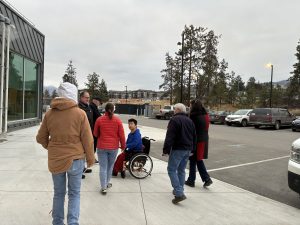
Bringing Together People and Expertise
This project demonstrates the power of integrating Urban Matters’ equity-driven approach with Urban Systems’ technical expertise—bringing systems thinking, community insight, and data together to create practical, lasting change.
Sarah Manteuffel, one of the project team members shared:
“As a person with a disability, I understand first-hand how important it is value lived experience and recognize it as a form of expertise. Working in accessibility and inclusion as a practice allows me to apply my experience to our work and guide our team. Most importantly, it allows for the additional prioritization and trust of the lived-experience voices of our clients and communities. This project was an incredible example of this, and produced a final product that was not only beneficial for the community, but based directly from their expertise.”
Accessibility is often included in plans and policies, but guidance is not always provided to translate these ideas into action. This project offers an example of how community expertise can support recommendations that respond to local needs and context. When communities are trusted as experts in their own experiences—and given the tools to contribute—better, more inclusive outcomes are possible.
Moving Forward
The City of West Kelowna plans on presenting the findings in the coming months, with many recommendations already helping inform discussions related to future planning and improvements. From the outset, the City demonstrated a willingness to try something new, moving beyond traditional approaches and embracing a model that puts community members first. Now that the tool has been developed, it can be adapted for accessibility audits in recreation facilities, parks, and other community amenities, helping create more accessible, vibrant communities.
Melissa Hunt-Anderson, a Community & Social Development Coordinator for West Kelowna, shares what makes this project so impactful:
“What made this project especially impactful was that the auditors were not simply “consulted” — they were directly involved in assessing real-world accessibility barriers in the community and identifying practical, implementable solutions. Their lived experience helped identify challenges that may otherwise have been overlooked, including issues related to accessible parking signage, sidewalk continuity, crossings, transit access, lighting, and wayfinding.”
As we recognize National AccessAbility Week, we’re proud to have collaborated with the City of West Kelowna on this meaningful work—supporting a project that not only highlights the importance of accessibility, but helps shape how communities can move forward in more equitable and inclusive ways.